
You have completed your run-up. Your passenger is excited. The airplane ahead of you is departing, and you are almost ready to fly.
Then the radio crackles. You hear your call sign, a runway number, and an instruction you were expecting. You release the brakes.
But did you actually hear what you thought you heard?
Runway mistakes often begin with something ordinary: an assumption, a distraction, an unfamiliar intersection, or the pressure to keep moving. The consequences can become serious before the airplane ever leaves the ground. A wrong turn can put you in conflict with another aircraft; an unsuitable runway or lost directional control can put obstacles in your path.
And the risk does not end at touchdown. A hurried turnoff or an airplane stopped with its tail still inside the runway holding position can create another conflict just when the pilot thinks the hard part is over.
Good runway habits matter throughout the flight, from choosing a suitable runway during preflight planning to clearing it completely after landing. These ten mistakes follow that sequence. They apply to student pilots learning airport operations and certificated pilots who want to keep familiar routines from becoming careless ones.
The focus here is runway use: preparation, authorization, identification, traffic awareness, available distance, control, and clearing. Each deserves attention even when your takeoffs and landings otherwise feel comfortable.
Phase 1: Preflight Planning
1. Skipping Runway NOTAMs and Airport Information
An airport diagram tells you how an airport is arranged. It does not, by itself, tell you everything that is happening there today.
A familiar taxiway may be closed. Construction may have changed the route to the departure end. A runway may be temporarily shortened. Lighting you were counting on may be unavailable. If you arrive expecting yesterday's airport, today's airport can surprise you.
Before the flight, review the airport diagram, relevant Chart Supplement information, and current NOTAMs for both departure and destination. Identify runway and taxiway closures, construction areas, restrictions, and published hot spots. A hot spot marks an area with a history or potential risk of collision or runway incursion; it deserves a deliberate look before you reach it. FAA runway-safety guidance specifically includes reviewing diagrams, hot spots, NOTAMs, and current airport information as part of preparation.
Turn that review into a usable mental picture. Where will you probably taxi? Which runways might you cross? Where could a confusing turn put you somewhere you did not intend to go?
Include the visual aids relevant to your arrival. VASI and PAPI systems provide visual approach-slope guidance. Runway End Identifier Lights, or REILs, help identify the approach end of a runway. These serve different purposes, and an outage may change how comfortable you are with a particular arrival, especially at night.
You do not need to turn preflight planning into a lecture on every airport light. You do need to know whether the aids you expect will be available.
Keep the diagram accessible during taxi, and update your picture with ATIS or other available airport information. Preparation should continue to guide your decisions after the engine starts.
2. Choosing a Runway Without Checking Whether It Is Suitable
The runway everyone else is using may be convenient. That does not establish that it is suitable for your airplane, loading, conditions, and proficiency.
Runway selection involves more than finding the most favorable wind direction. Consider wind speed, gusts, crosswind and tailwind components, usable runway length, surface condition, slope, obstacles, and the airplane's expected performance. Your gross weight, configuration, and density altitude all matter. Use the performance information and limitations applicable to your aircraft.
A lightly loaded airplane on a cool morning can perform very differently from the same airplane carrying more weight on a hot afternoon. Your memory of an easy departure last winter is not a performance calculation for today's flight.
Separate the distance needed to leave the ground from the distance and climb performance needed to clear obstacles. Becoming airborne before the pavement ends does not answer whether you can safely climb beyond the airport. For landing, distinguish ground roll from the total distance associated with clearing an obstacle and touching down under the conditions assumed by the performance data.
Surface conditions deserve the same attention. Wet pavement, standing water, snow, ice, or a soft surface can change the problem substantially. Do not invent a correction factor when suitable data are unavailable. Recognize when uncertainty itself makes the runway a poor choice.
Build a margin appropriate to the operation rather than planning to use every foot predicted by a chart. Also consider whether the expected wind is within your capabilities, even when it does not exceed an aircraft limitation.
At a towered airport, request another runway when necessary. If a suitable option is unavailable, waiting or changing the plan may be the right decision. ATC can assign a runway; the pilot must still determine whether the operation can be conducted safely.
Phase 2: Approaching and Entering the Runway
3. Crossing a Hold-Short Line Without the Required Authorization
The hold-short line is a decision boundary. Treat it that way.
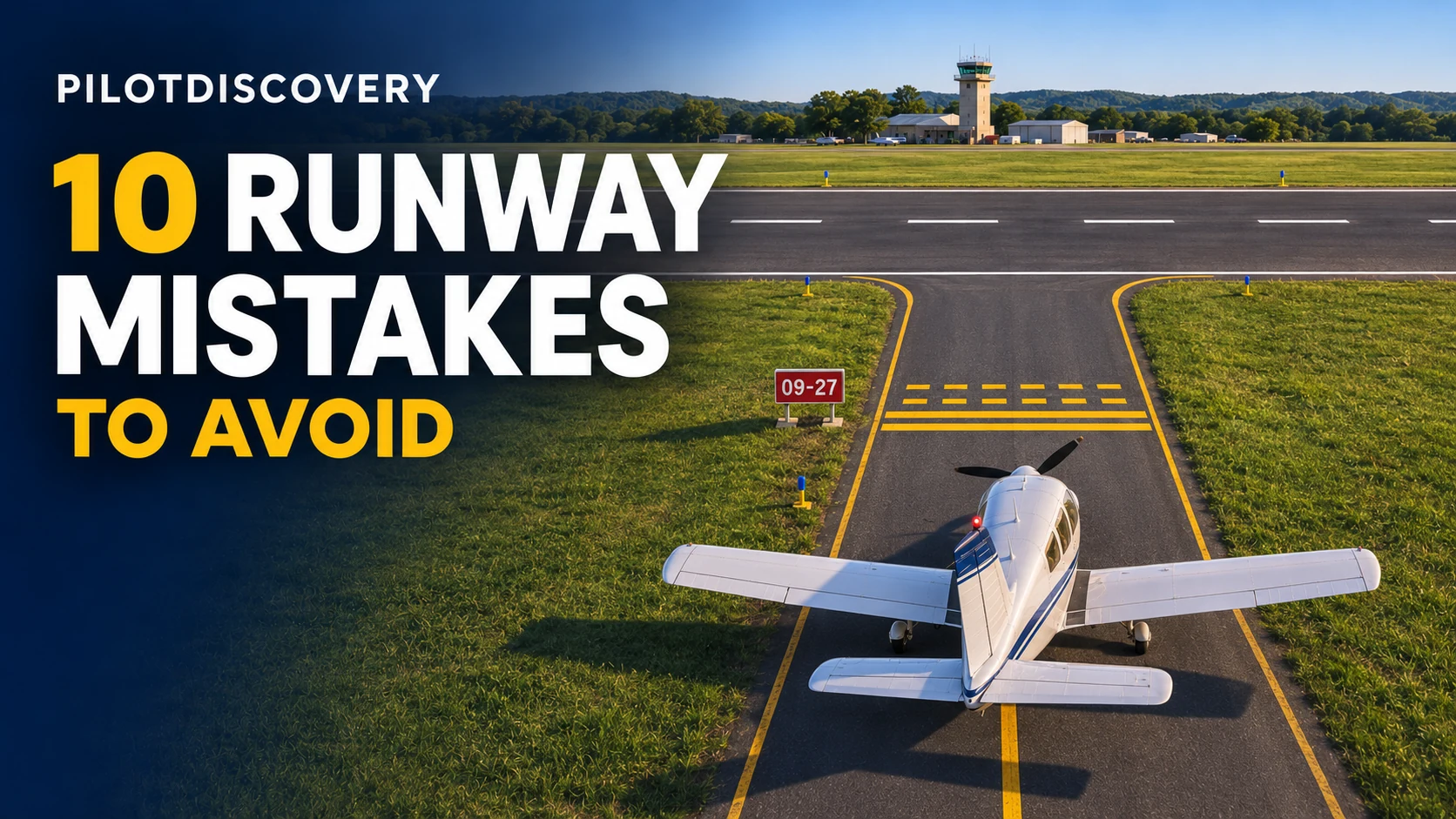
Standard runway holding position markings consist of two solid and two dashed yellow lines. When approaching the runway from the solid-line side, stop before the marking unless you have the required authorization to proceed. Position the airplane so that no part extends beyond the holding position marking.
At an airport with an operating control tower, a taxi clearance does not automatically authorize crossing a runway along the way. Obtain explicit clearance for each runway crossing. An apparently empty runway does not supply the missing permission.
Read back runway hold-short instructions with the runway identification and your call sign. Make the readback a conscious confirmation of the boundary you must respect, rather than a phrase you repeat while already thinking about departure.
At a nontowered airport, there is no tower clearance to obtain. You still must determine that entering or crossing will not conflict with other traffic. A radio announcement communicates your intention; it does not reserve the runway or establish that it is safe to proceed.
Imagine receiving taxi instructions with one runway crossing followed by a hold-short instruction for another runway. If you remember only the destination runway, you can erase an important restriction from your mental plan.
Write down complex instructions, follow your progress on the diagram, and identify the next stopping point before moving. If you lose your place, stop safely before the runway boundary and clarify. The time to resolve uncertainty is while you still have room to remain clear.
4. Following Instructions You Do Not Understand—or Cannot Safely Comply With
Hearing an instruction, understanding it, and being able to carry it out are three separate things.
Perhaps the controller spoke quickly. Perhaps another transmission blocked the runway number. Perhaps you heard your call sign but missed the taxiway. Continuing because you understood most of the message can turn a small communication problem into an aircraft-position problem.
Ask for clarification before acting on the uncertain part. Use plain, direct language. Request a repeat, confirm a runway assignment, or ask for progressive taxi instructions when needed. If you are already taxiing, stop in a safe location while resolving the uncertainty; avoid creating a new hazard by stopping in an intersection or on a runway unnecessarily.
There is another version of this mistake: understanding an instruction perfectly and accepting it despite knowing you cannot safely comply.
An intersection departure might leave inadequate runway. An assigned runway might create an unacceptable crosswind for you. A requested exit might require more braking or a sharper turn than you can safely manage. Tell ATC promptly and request an alternative.
The pilot in command is responsible for the operation of the aircraft. That responsibility belongs alongside the obligation to comply with applicable ATC instructions and clearances. Resolve a foreseeable conflict by communicating your inability and obtaining an amended instruction, rather than silently improvising.
For example, requesting full length before entering the runway is far easier than discovering, while lined up, that the intersection departure does not meet your performance needs.
Professional communication includes saying that you are unsure or unable. It gives the controller information needed to develop a workable plan.
5. Entering Without Checking Traffic and Clearly Communicating Your Intentions
The radio gives you part of the traffic picture. Your eyes provide another part. Use both.
Before entering or crossing, look along the runway and toward the approach path. Consider traffic on intersecting runways and other aircraft or vehicles that could create a conflict. Continue looking as you move; a single glance several seconds earlier may no longer describe the situation.
At a towered airport, receiving clearance does not make an apparent conflict irrelevant. If something looks wrong, remain clear when possible and tell the controller. Clarify the situation before proceeding into it.
At a nontowered airport, do not assume that a quiet frequency means an empty pattern. An aircraft may be operating without a radio, a transmission may have been blocked, or you may have selected the wrong frequency. Likewise, a traffic display may help your awareness, but it is not a complete inventory of everything around the runway.
Make clear calls on the appropriate frequency. At a nontowered airport, identify the airport, your aircraft, your position, the runway involved, and your intention as appropriate to the situation. Use recognizable locations and standard terminology so listeners can build an accurate picture.
Then listen. A useful transmission does little good if you immediately turn your attention away from a conflicting position report. For the airborne side of that shared traffic picture, see 20 Common Mistakes Pilots Make Flying the Traffic Pattern.
Consider a pilot announcing departure on one runway while another aircraft reports final for the opposite direction. The essential task is to recognize and resolve the conflict before entering. Repeating your own intention more forcefully does not solve it.
Your goal is shared understanding backed by a visual check. Neither confident radio work nor a quick look should become an excuse to neglect the other.
6. Entering the Wrong Runway, Intersection, or Direction
You can understand your clearance and still put the airplane in the wrong place.
A wide taxiway can resemble a runway. Two parallel runways can look deceptively similar. An intersection can feel familiar even though you approached it from a different direction. Expectation encourages you to recognize what you intended to find.
Before entering, compare the clearance or intended operation with the signs, markings, diagram, and actual pavement in front of you. Confirm the runway number and any left, right, or center designation. Confirm the intersection when an intersection departure is involved.
Once aligned, cross-check the aircraft's heading against the runway's approximate magnetic direction. Runway 27 should put you roughly westbound, allowing for the relationship between runway numbering and current magnetic heading. A major disagreement demands an explanation before takeoff.
That heading check cannot distinguish two parallel runways with the same basic orientation. It is one check among several. The runway designation, location, and clearance must agree too.
Arrival requires the same discipline. Confirm that the surface you are approaching is the intended runway, especially where parallel runways, parallel taxiways, or nearby airports make misidentification plausible. If identification remains uncertain, address it early enough to avoid forcing the situation close to touchdown.
Keep runway identification separate from runway suitability. Mistake number two asks whether the planned runway works for the flight. This mistake asks whether you have actually identified that runway and the correct place to enter it.
A brief verbal confirmation can help: runway, direction, intersection, authorization. If the pieces disagree, pause and resolve the mismatch.
Phase 3: Using the Runway
7. Treating “Line Up and Wait” as Permission to Take Off
The airplane is aligned. The runway ahead looks clear. The aircraft that caused the delay has turned off. You are ready.
None of those observations is a takeoff clearance.
“Line up and wait” authorizes you to enter the assigned runway, align in the departure direction, and wait for further instructions. It does not authorize beginning the takeoff roll. The FAA specifically warns that pilots have correctly read back this instruction and then departed without clearance.
Expectation is the trap. You anticipate the next instruction so strongly that the conditions around you begin to feel like permission.
Maintain a clear distinction between being positioned for departure and being cleared for departure. Before beginning the roll, confirm that the takeoff clearance was issued to your aircraft for your runway. Similar call signs and simultaneous operations on other runways can create opportunities to accept someone else's clearance mentally.
While waiting, continue monitoring the frequency and looking for conflicts. If a clearance does not arrive within a reasonable time, or the traffic situation concerns you, contact the tower. Do not let uncertainty build while you sit on the runway assuming someone will notice.
This is also a poor time to finish programming equipment or conduct a conversation with a passenger. Your attention belongs on the runway environment and the instructions that determine what happens next.
The safe habit is explicit: alignment gets you ready; the applicable takeoff clearance authorizes the departure. Verify it before adding power for the takeoff roll.
8. Giving Away Usable Runway Without Reassessing What Remains
An intersection departure can save taxi time. It also changes the distance available for takeoff.
The number published for the full runway does not follow you to the intersection. If you begin partway down the pavement, the performance decision must use the applicable remaining distances.
Suppose a runway is 5,000 feet long, but your proposed entry leaves 3,000 feet ahead. Those figures are an illustration, not a performance recommendation. The question is whether the shorter departure meets your airplane's performance requirements, obstacle-clearance needs, conditions, and chosen margin today.
Obtain the relevant distance information before accepting the departure. At a towered airport, request the distance if needed and ask for full length when appropriate. FAA guidance places responsibility on pilots to account for the reduction associated with an intersection departure.
Available pavement also requires interpretation. A displaced threshold changes where landing in that direction may begin; the pavement before it may be available for other operations, subject to applicable restrictions. A blast pad or stopway is not simply extra runway you can add to your takeoff plan. Published declared distances, where provided, can differ from the physical pavement length.
Avoid casual shortcuts such as assuming that every paved foot is usable for every purpose.
The same attention to remaining distance matters on arrival. If an approach carries you beyond your planned touchdown area, you are using up runway before the landing roll begins. Follow your established landing and go-around criteria rather than trying to rescue the plan through aggressive braking after a late touchdown.
This is where runway use touches landing technique directly: the flight must leave sufficient usable distance for the operation you are actually performing.
9. Losing Directional Control or Treating the Centerline as Optional
Runway length gets considerable attention. Runway width deserves respect too.
An airplane does not need to reach the far end of a runway to depart the pavement. A takeoff that begins poorly aligned, a landing rollout with growing drift, or a distraction at the wrong moment can consume the available lateral margin.
Establish proper alignment before beginning the takeoff roll. Starting a rushed turn onto the runway and adding takeoff power before you are ready creates extra work during a phase that already requires close attention.
Track the centerline and apply the appropriate directional and crosswind controls for your airplane and conditions. Those inputs change as speed changes. During landing rollout, continue flying the airplane after the wheels touch; touchdown does not end the need for active control.
Keep your eyes outside and look far enough ahead to recognize drift early. A deviation that is easy to correct when small can become much more difficult if you allow it to grow while looking inside.
Think about a gust arriving just as you reach for a switch. The switch will still be there a few seconds later. The airplane's position relative to the runway edge is changing now.
If directional control is deteriorating during takeoff, apply your aircraft procedures and the reject criteria established with appropriate training. Do not assume that accelerating will make an unresolved control problem disappear.
For landing, the detailed techniques for managing speed, bouncing, and other touchdown problems deserve their own discussion. Here, the essential runway habit is continuous control: align deliberately, recognize drift promptly, and maintain attention throughout the roll.
Phase 4: Exiting and Clearing the Runway
10. Occupying the Runway Unnecessarily—or Calling Clear Before You Are Clear
After landing, two competing pressures can appear. You want to get out of the way, and you want to begin the after-landing tasks.
Both need to wait for safe aircraft control and a suitable exit.
Clear the runway promptly when you can do so safely. Plan for likely taxiways, but remain willing to use a later suitable exit if the first one would require excessive braking or an unsafe turn. Tell ATC promptly if you cannot make an assigned exit.
Do not improvise a turn onto another runway at a towered airport without the appropriate instruction or authorization. An intersecting runway is not an ordinary taxiway just because it provides a convenient path off your landing runway.
Once you turn off, keep moving far enough for the entire airplane to pass beyond the runway holding position marking, unless directed otherwise. The nose being off the pavement is not enough. Your tail can still leave part of the aircraft inside the protected runway area.
The FAA's runway-safety guidance explicitly reminds pilots that the whole aircraft must be past the holding position marking to be clear.
Only report clear when you actually are. At a nontowered airport, a premature runway-vacated call can give an arriving pilot an inaccurate picture. At a towered airport, remain on the appropriate frequency and follow instructions for subsequent taxi and frequency changes.
Defer the after-landing checklist until clear and in a suitable position to perform it without compromising taxi safety. Your passenger's question, the flap switch, and the navigation screen can all wait while you finish getting the airplane out of the runway environment.
The operation is complete when you have exited safely, cleared fully, and understood where you are going next.
Build a Runway Habit You Can Repeat
These mistakes share a common vulnerability: moving ahead while an important question remains unanswered.
Before taxi, understand today's airport and confirm that the planned runway suits the flight. Before entering, verify position, authorization, traffic, and intention. Before taking off, confirm runway identity, usable distance, alignment, and the clearance required for your operation. After landing, maintain control and clear completely before shifting attention to secondary tasks.
Give yourself permission to interrupt the routine. Ask for the instruction again. Request full length. Decline an unsuitable runway. Take the next safe exit. A brief delay can preserve the time and space you need to make a sound decision.
For a closer look at touchdown problems, read our companion guide, 7 Landing Mistakes That Can Wreck Your Airplane. It continues the discussion with the landing techniques that fall outside this runway-use checklist.
Want more structure for your next flight? Download the free 40-page Private Pilot Checklist Toolkit when you join Flight Following, the PilotDiscovery newsletter: Get your free Private Pilot Checklist Toolkit.
On your next flight, make each runway boundary a conscious decision point. Know where you are, what you are authorized to do, and whether the airplane and conditions support what comes next.
FAA References
- Pilot Best Practices for Airfield Safety
- AIM, Airport Operations
- AIM, Airport Marking Aids and Signs
- AIM, Departure Procedures (including Line Up and Wait)
- AIM, Airport Lighting Aids
- Pilot's Handbook of Aeronautical Knowledge, Aircraft Performance
- AC 91-73B, Single Pilot and Flight School Procedures During Taxi Operations
- 14 CFR 91.3, Responsibility and Authority of the Pilot in Command