
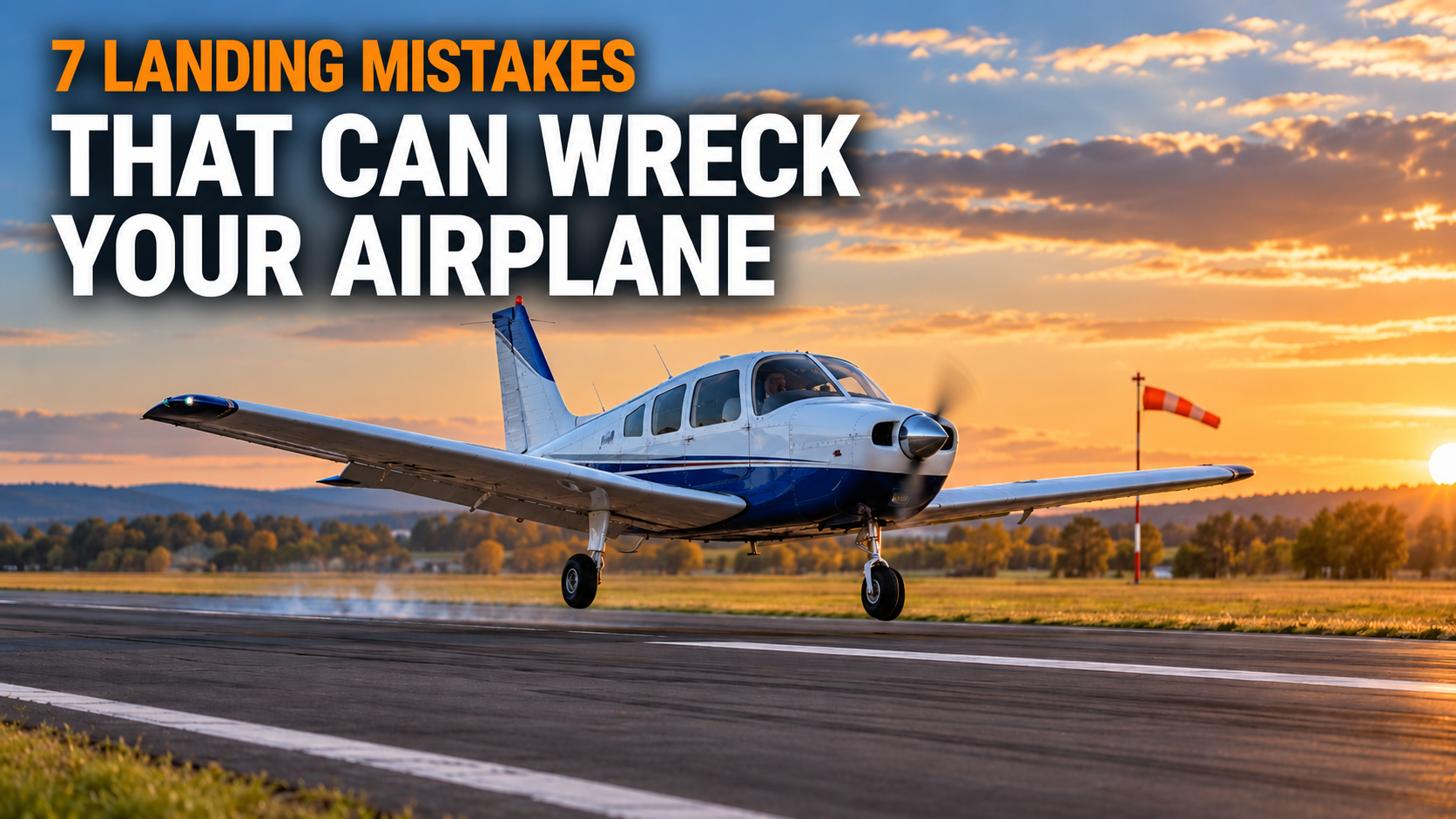
There is a simple phrase that captures one of the biggest truths in primary flight training: A good approach makes a good landing.
That does not mean every stabilized approach ends with a perfect touchdown. Gusts change, judgment is imperfect, and experienced pilots occasionally arrive with more energy—or less finesse—than intended. But serious landing problems rarely begin when the wheels touch. They begin earlier, when the airplane is too fast, poorly aligned, incorrectly configured, or descending on a path that demands increasingly aggressive corrections.
The seven mistakes in this guide—approaching too fast, forcing the airplane onto the runway, ballooning, bouncing, porpoising, mishandling a crosswind, and waiting too long to go around—are connected. One error can produce the next. Understanding that chain is more useful than memorizing seven isolated definitions.
This guide discusses general principles for light airplanes. Always follow the limitations, procedures, and recommended airspeeds in the specific aircraft’s FAA-approved AFM/POH, and practice recovery techniques with a qualified flight instructor.
The Landing Usually Goes Wrong Before the Flare
A landing is the result of earlier decisions: pattern spacing, configuration, descent planning, airspeed, runway alignment, wind correction, and the aiming point. When these elements work together, the airplane reaches the roundout with enough time and runway to reduce its descent and settle onto the main wheels.
When they do not, the pilot carries a problem across the threshold. Excess speed creates floating. A rushed approach provokes an abrupt flare. Poor alignment demands a late crosswind correction. A touchdown with excess energy becomes a bounce, and a pilot who chases that bounce can create a porpoise.
Before the flare, ask whether the airplane is configured, on the target speed specified by the POH and your instructor, descending predictably, aligned with the centerline, and capable of touching down in the planned zone without aggressive corrections. If not, the safest correction may be a go-around.
1. Approaching Too Fast
Extra airspeed can feel reassuring. A pilot may think a few additional knots provide protection against a stall or make the controls more responsive. But unnecessary speed does not disappear at the threshold. It becomes energy that must be dissipated before the airplane can land and stop.
A fast airplane tends to float in ground effect. As the intended touchdown area passes beneath the nose, impatience grows and the temptation to “put it down” increases. Excess approach speed can consume runway, encourage a forced touchdown, increase brake demand, and leave less room if a bounce develops.
The solution is not one universal number. Fly the manufacturer’s recommended approach speed, adjusted appropriately for conditions, weight, and your operating procedures. Establish it early enough that final is stable rather than a last-second attempt to lose energy.
Warning sign: You cross the threshold fast, float beyond the intended touchdown zone, and feel pressure to make the wheels touch. That pressure is evidence that your margin is shrinking.
2. Forcing the Airplane Onto the Runway
A landing is not completed by aiming the nosewheel at the pavement. In a typical tricycle-gear trainer, the airplane should reach the proper landing attitude and touch down on the main wheels while the pilot continues managing pitch, alignment, and drift.
When the airplane floats, some pilots push forward or abruptly relax back pressure. The airplane may strike the runway while it still has enough energy to fly. A flat or nosewheel-first touchdown loads the wrong part of the landing gear and can start a bounce or porpoise.
Maintain directional control, shift your vision down the runway, and continue the roundout and flare using the technique appropriate to the airplane. Allow it to decelerate into the touchdown attitude. If runway is disappearing or the correct attitude requires an abrupt input, go around. Crossing the threshold never obligates you to finish the landing.
3. Ballooning During the Flare
A balloon occurs when the airplane rises during the roundout or flare. It commonly results from raising the nose too rapidly or applying excessive back pressure, especially with extra airspeed.
The danger is not simply the climb. Airspeed is decreasing while the airplane is now higher above the runway. If the pilot freezes, it may stall and drop. If the pilot shoves the nose down, the correction may produce a hard or nosewheel-first touchdown.
The response depends on severity, runway remaining, wind, aircraft, and proficiency. A slight balloon may sometimes be corrected with a small adjustment while preserving the proper landing attitude, with power as appropriate. A pronounced balloon, significant airspeed loss, or uncertain recovery should trigger a go-around.
Avoid turning one excessive input into another in the opposite direction. Large corrections close to the surface mean the landing is no longer comfortably under control. Prevention begins with arriving on speed, looking farther down the runway, and increasing back pressure progressively.
4. Bouncing After Touchdown
A bounce occurs when the airplane touches the runway and becomes airborne again. It may follow a fast approach, improper touchdown attitude, high descent rate, or landing-gear rebound after a firm contact.
The important question is not whether the pilot can save face. It is whether the airplane can be returned to a normal landing attitude with adequate airspeed, control, and runway remaining.
A very small bounce may be recoverable if the pilot maintains direction, avoids abrupt pitch changes, and uses aircraft-appropriate technique. A high, hard, or increasing bounce should not be chased down the runway. Apply go-around power and follow the POH and your training.
Pushing the nose down as the airplane rises can drive the nosewheel into the pavement and begin oscillations. Trying to hold the airplane off without accounting for rapidly decaying airspeed can make the second touchdown harder than the first. If you cannot immediately describe the bounce as slight and controlled, uncertainty itself is a reason to go around.
5. Allowing a Bounce to Become a Porpoise
Porpoising is a series of pitch oscillations in which the airplane repeatedly contacts the runway—often alternating between nose gear and main gear—with each cycle potentially becoming more severe. It can damage the nose gear, propeller, firewall, or airframe.
It is often pilot-induced. Following a flat or nose-first touchdown, the airplane pitches up. The pilot pushes forward, the nosewheel strikes, and the pilot pulls back, amplifying the next cycle. One poor touchdown becomes a rapidly escalating sequence.
Do not try to time increasingly large elevator movements against the oscillations. A developing porpoise calls for an immediate go-around using the correct aircraft procedure while maintaining directional control. Follow the POH and instructor guidance for power, pitch, flap retraction, and obstacle clearance.
After a severe propeller strike, suspected structural damage, or loss of controllability, the situation may no longer resemble a routine rejected landing. This is why recovery must be practiced with an instructor and why preventing the first nosewheel-first touchdown matters. A bounce may leave a decision; a porpoise means the landing attempt has already deteriorated.
6. Using Improper Crosswind Correction
A crosswind landing has two objectives: keep the flight path over the runway centerline and keep the airplane’s longitudinal axis aligned at touchdown. Correcting only one is insufficient.
On final, a crab may maintain the desired ground track. Before touchdown in many light airplanes, the pilot transitions to a wing-low sideslip: aileron into the wind to stop drift and opposite rudder to align the nose. Technique and timing should match the aircraft and instruction received.
Common errors include removing correction in the flare, using rudder to chase lateral drift, touching down while moving sideways, and relaxing the aileron after touchdown. Wind correction continues through rollout. As the airplane slows and controls become less effective, progressively more aileron into the wind may be required.
If full appropriate control input cannot arrest drift, alignment cannot be maintained, or gusts make touchdown unpredictable, go around. A different runway, another airport, or better conditions may be the professional choice.
7. Failing to Go Around Soon Enough
A go-around is not an admission that the pilot cannot land. It is a normal maneuver that protects the airplane and its occupants when the conditions for a safe landing no longer exist.
Pilots delay because they are close to the runway, have invested effort in the approach, fear disappointing an instructor, or believe one more correction will fix everything. This is continuation bias: persisting with the original plan after the evidence supporting it has disappeared.
Set triggers before the approach. Go around if the approach is not stabilized by the point specified in your training; airspeed, descent, configuration, or alignment exceeds acceptable limits; the runway is occupied; the airplane floats beyond the planned zone; a balloon or bounce is more than slight; crosswind correction cannot stop drift; or you simply dislike what you see.
Execute positively according to the POH: add power, control pitch, manage configuration in sequence, anticipate trim and left-turning tendencies, maintain runway alignment, and communicate as workload permits. The earlier the decision, the more runway, airspeed, altitude, and mental capacity remain.
How These Seven Mistakes Connect
These mistakes frequently form one chain:
- The airplane turns final high or carries excess airspeed.
- It crosses the threshold fast and floats.
- The pilot tries to force it onto the runway.
- The airplane balloons or touches down flat and bounces.
- The pilot makes abrupt forward-and-back pitch corrections.
- The bounce develops into a porpoise.
- The go-around comes only after the situation becomes severe.
Crosswind drift can enter anywhere in the chain, adding side load, misalignment, and runway-departure risk. The best place to break the sequence is at the beginning: recognize the unstable approach and go around before the flare. The next-best point is the first unmistakable warning—the excessive float, significant balloon, or bounce. Every attempt to rescue a deteriorating landing consumes margin.
A Practical Landing Discipline
Safe landings depend on repeatable habits rather than last-second talent.
- Brief the landing. Review runway, wind, target speeds, configuration, touchdown zone, crosswind plan, and go-around procedure.
- Stabilize early. Establish the correct energy, alignment, and descent path before the runway fills the windshield.
- Guard against extra speed. Do not add arbitrary knots “for safety.” Use the POH and appropriate wind adjustments.
- Look down the runway. During roundout, the far-end reference helps judge height, sink, and alignment.
- Keep flying after touchdown. Maintain pitch, direction, and wind correction through rollout.
- Practice go-arounds. Work with an instructor from different points in the approach and landing sequence.
A go-around practiced only at altitude or initiated only when an instructor commands it may not become instinctive when a real landing deteriorates. Practice noticing the cues and making the decision yourself.
Frequently Asked Questions
Can every bounced landing be recovered?
No. A slight bounce may sometimes be recoverable with proper technique, but a high, hard, or increasing bounce warrants a go-around. Aircraft, runway remaining, wind, airspeed, and proficiency all matter.
Should I add power during a balloon?
It depends on severity and aircraft procedure. Power may help arrest sink during a slight correction, while a pronounced balloon should usually lead to a go-around. Learn the response in your airplane with an instructor.
What is the difference between bouncing and porpoising?
A bounce is a touchdown followed by becoming airborne again. Porpoising is an escalating series of pitch oscillations and runway contacts, often involving the nose gear, and is much more likely to cause serious damage.
Can I go around after the wheels touch?
Yes, when the aircraft remains controllable and the maneuver can be safely performed. This is often called a rejected landing. The precise procedure and judgment depend on the aircraft and circumstances.
What if my landings suddenly get worse?
Stop trying to solve the problem through repetition alone. Fly with a qualified instructor who can observe your sight picture, airspeed discipline, control inputs, and decisions. A short proficiency session can expose a habit that is difficult to diagnose from the pilot seat.
Final Thoughts
Landing skill is not measured by how often you rescue a bad approach. It is measured partly by how early you recognize that the landing should not continue.
Manage energy before the threshold. Do not force the airplane down. Use smooth, proportionate inputs. Maintain crosswind correction through rollout. When a balloon, bounce, or unstable approach exceeds your ability to correct safely, go around.
The phrase deserves repeating because the whole chain leads back to it: A good approach makes a good landing. And when the approach is not good, the best landing may be the one you choose not to make.
FAA References
Educational content only; not a substitute for instruction, the AFM/POH, or pilot-in-command judgment.